The temple that took 638 years
Work on the Olympieion began around 520 BC under the tyrant Peisistratos and his sons, who intended to rival the great temples of the Greek world. When the tyranny ended in 510 BC the project stalled, and the half-built temple stood unfinished for centuries. It was the Roman emperor Hadrian who completed it, dedicating it in AD 131–132 as part of his lavish building programme for the city he admired.
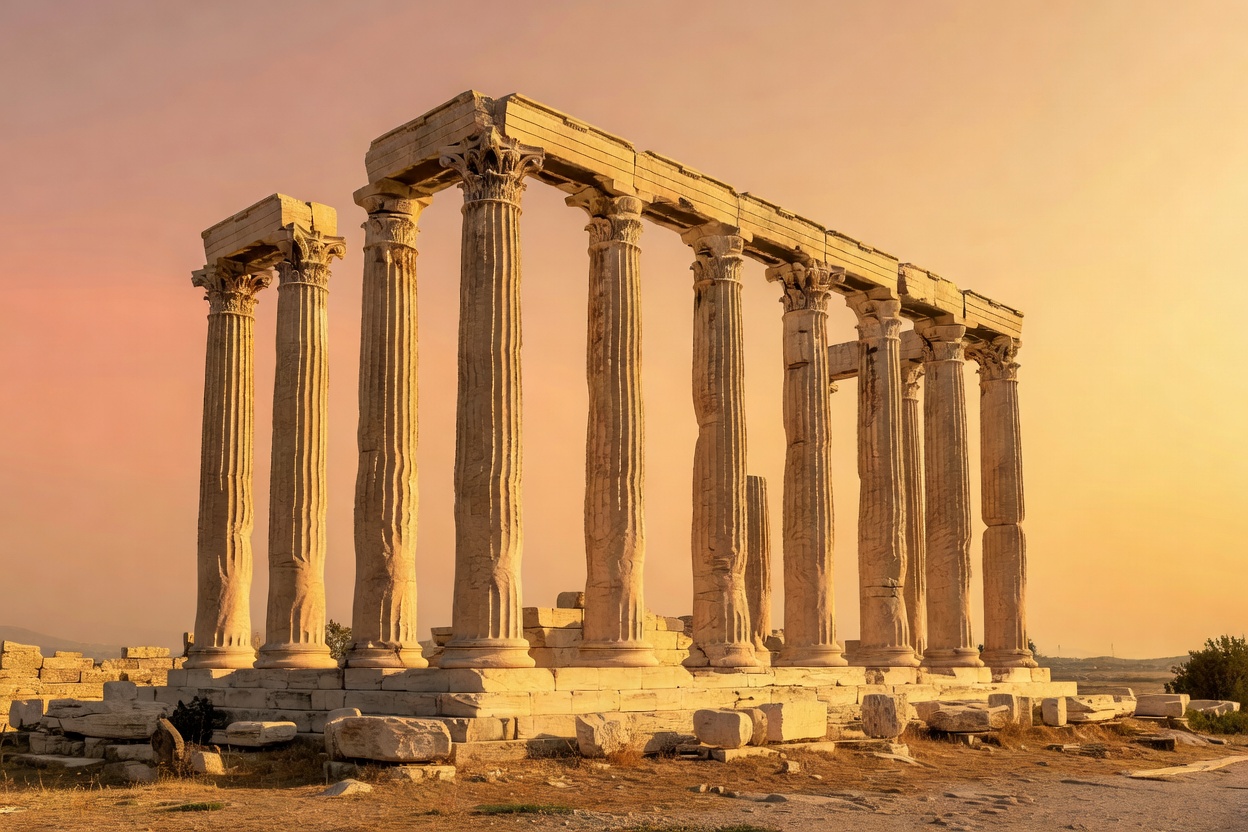
In its prime the temple had 104 Corinthian columns, each about 17 metres high, arranged in double rows along the flanks and triple rows at the ends. It was the largest temple in Greece. After it fell out of use in late antiquity, much of the stone was carried away for other buildings. Today fifteen columns stand, and a sixteenth lies on the ground where it fell in a storm in 1852.
What to see
- The standing columns: a cluster of thirteen in the south-east and two further columns linked by an architrave, giving you the best sense of scale.
- The fallen column: its drums are stacked like coins, letting you see the construction method.
- Hadrian's Arch: a marble gateway of about AD 131 on Amalias Avenue, with inscriptions marking the "city of Theseus" on one side and the "city of Hadrian" on the other.
- Sanctuary remains: traces of the precinct wall, Roman baths and earlier foundations.
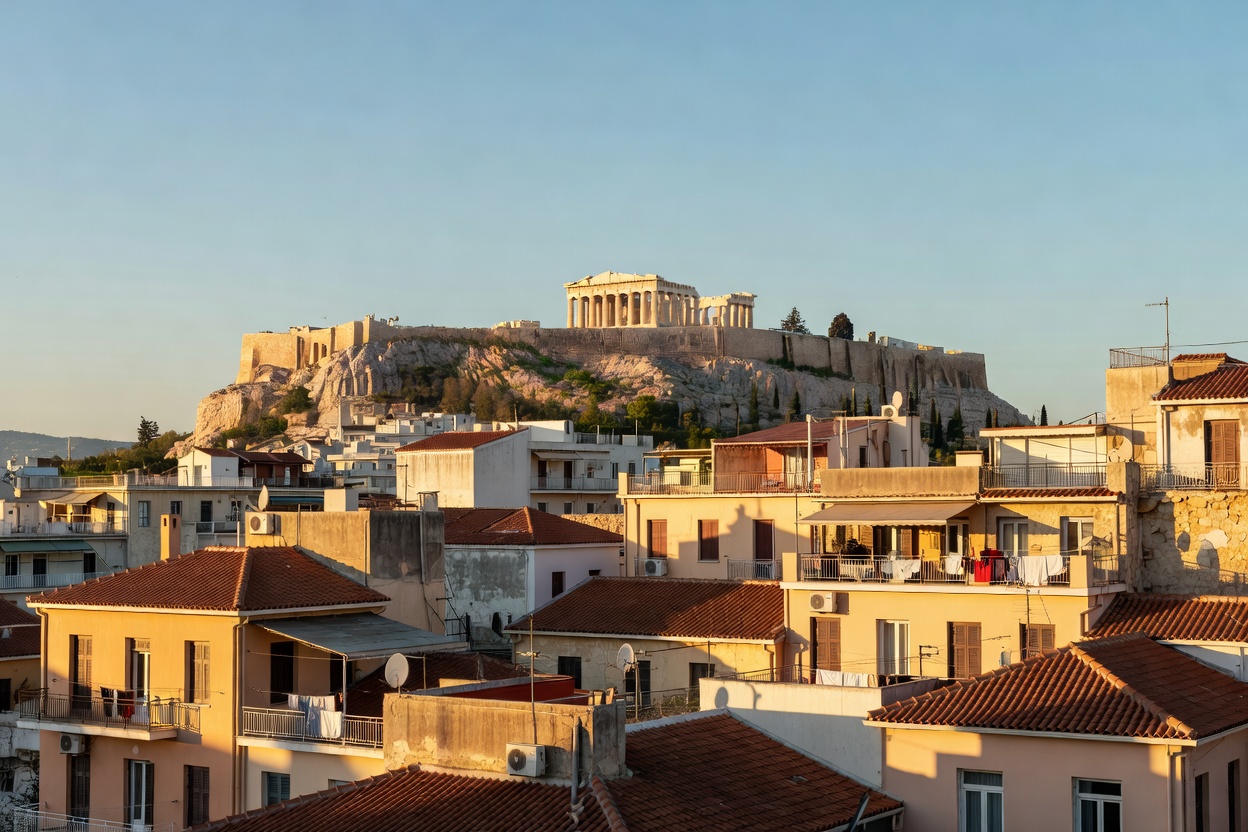
- Views: columns frame the Acropolis behind, particularly good in the afternoon.
Information panels
Historical significance
- Begun c. 520 BC, completed AD 131–132 under Hadrian.
- Once the largest temple in Greece, with 104 columns.
- Close to the Panathenaic Stadium, where the first modern Olympic Games were held in 1896.
Ticket prices
- Standard admission is around €10.
- Entry is usually included in multi-site tickets offered by the Ministry of Culture; confirm current combinations.
- Reduced and free categories follow national rules.
- The exterior can be viewed from the pavement for free, but you cannot walk among the columns.
Opening hours
- Open daily in most seasons, with longer summer opening times.
- Winter closing is earlier, often by mid-afternoon.
- Some public holidays are closed; check before you travel.
Recommended visiting times
- Late afternoon for warm light on the columns.
- Early morning for a quiet visit.
- Avoid midday in summer: there is almost no shade.
Nearby landmarks
- Hadrian's Arch, a two-minute walk.
- The National Garden and Zappeion Hall.
- Panathenaic Stadium, about 10 minutes on foot.
- Acropolis Museum, about 10 minutes away.
Practical visitor tips
- Bring a hat and water; the site is open and sunny.
- Take photos from the south side for the Acropolis backdrop.
- Consider pairing with the nearby Panathenaic Stadium visit.
- Paths are mostly level and suitable for most visitors.
Pros and cons
Highlights
- Fast to visit and easy to reach
- Dramatic scale and photographs
- Pairs naturally with Hadrian's Arch
Drawbacks
- Only the columns survive, with limited interpretation
- Very exposed to summer sun
- Can be viewed in part from outside the fence