The marketplace that shaped democracy
An agora was the open gathering place of a Greek city, and Athens' agora was its busiest. From the sixth century BC it was the site of markets, law courts, workshops, religious festivals and, after Cleisthenes' reforms of 508/507 BC, the new democratic institutions. Socrates is said to have spent his days questioning citizens here, and the apostle Paul addressed Athenians in the surrounding streets.
The Agora has been excavated since 1931 by the American School of Classical Studies at Athens, which relocated an entire neighbourhood of modern houses to expose the ancient layers. The work, still continuing, has produced thousands of inscriptions, coins, pottery fragments and voting tokens.
Highlights of the site
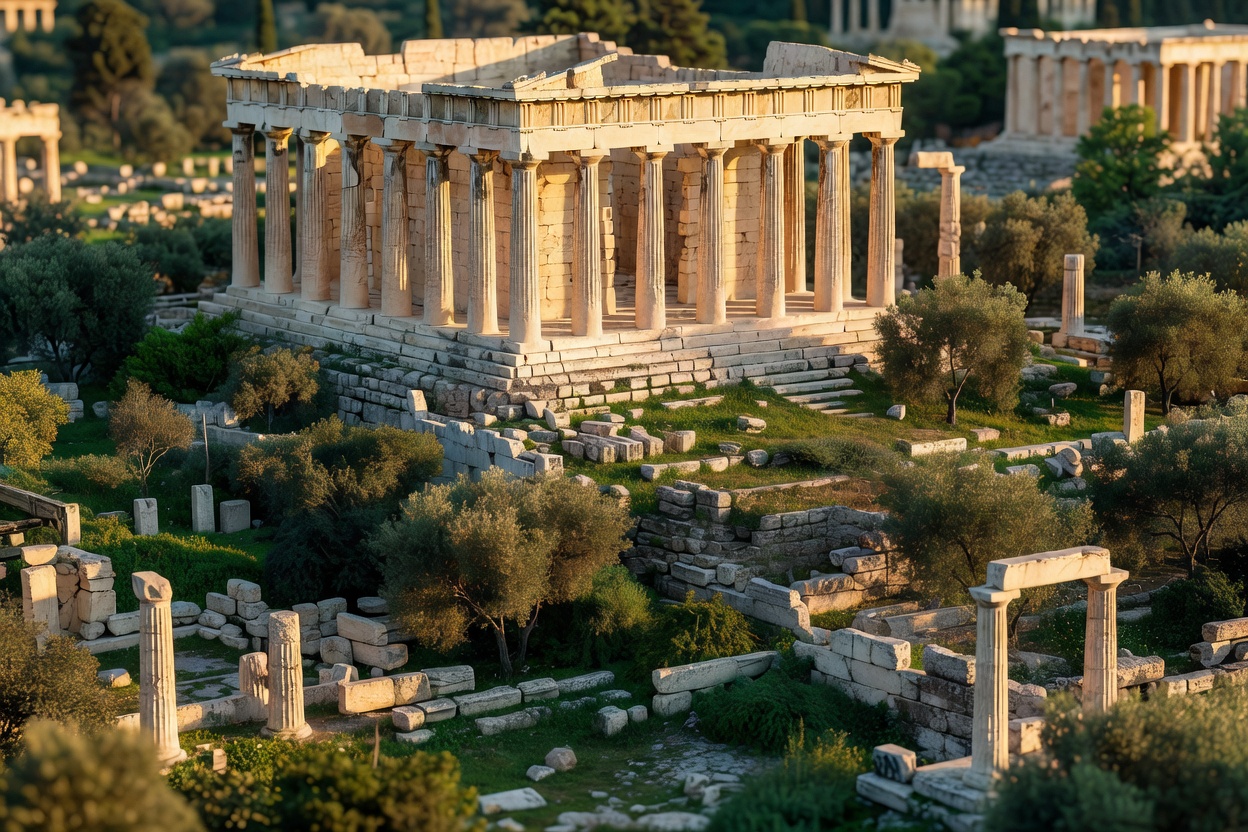
- Temple of Hephaestus: built from about 449 BC, this Doric temple is the best-preserved ancient Greek temple, retaining most of its columns and roof structure.
- Stoa of Attalos: a two-storey colonnade first built in the second century BC, reconstructed in the 1950s and now housing the Museum of the Ancient Agora.
- Church of the Holy Apostles: an eleventh-century Byzantine church with a restored interior.
- The Tholos and Bouleuterion: foundations of the round building where the executive committee of the council dined and the council chamber itself.
- Museum finds: look for ostraka (pottery shards used to vote for exile), bronze ballots and a water clock used to time speeches.
"Standing in the Agora, you are on the ground where the idea of citizen participation first took institutional form."
Information panels
Historical significance
- Public life of Athens centred here from the 6th century BC through Roman and Byzantine periods.
- Seat of democratic institutions: the council (boule), popular courts and magistrates.
- Destroyed by the Herulians in AD 267 and later reused for housing and churches.
Ticket prices
- Standard admission is around €10 and includes the Museum of the Ancient Agora in the Stoa of Attalos.
- Reduced and free categories mirror other state-run archaeological sites.
- A multi-site ticket may be available; verify current options before purchase.
- Check the Ministry of Culture ticket portal for up-to-date pricing.
Opening hours
- Summer: generally open from morning until early evening.
- Winter: earlier closing, often around 15:30–17:00.
- Closed on major public holidays.
- Last entry is about 15–30 minutes before closing.
Recommended visiting times
- Early morning: cool, quiet and ideal for photography of the temple.
- Late afternoon: warm light on the Temple of Hephaestus.
- Spring is exceptional, with wildflowers among the ruins.
Nearby landmarks
Practical visitor tips
- Wear comfortable shoes; paths are uneven gravel and stone.
- Look for the shady trees and benches for rest stops.
- Enter from Adrianou Street (Monastiraki side) or Polygnotou Street.
- Download an audio guide in advance to bring the ruins to life.
Pros and cons
Highlights
- Greener, calmer and more shaded than the Acropolis
- Superb Temple of Hephaestus photography
- Compact museum in a beautiful reconstructed stoa
Drawbacks
- Ruins are low and need imagination
- Limited signage in some corners
- Gravel paths can be hard for wheelchairs
Planning tip: Visit in the late afternoon, when the Temple of Hephaestus catches golden light and the Acropolis behind it turns amber.